
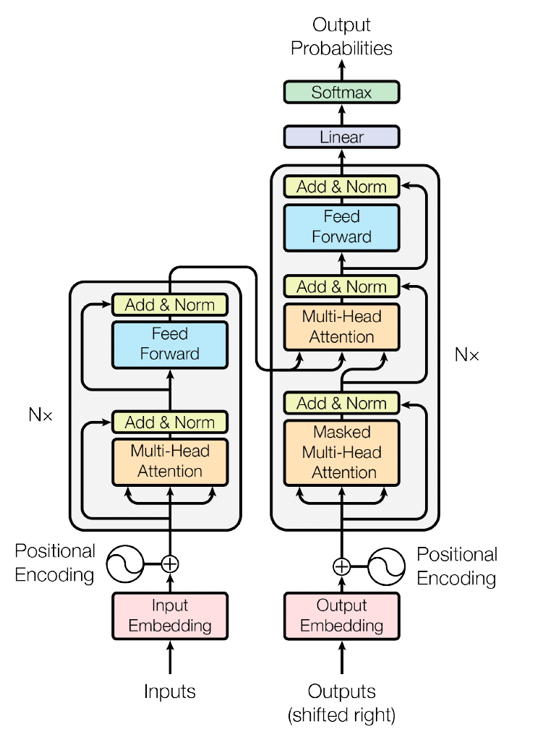
Transformer: The Core Architecture Behind Modern Artificial Intelligence
In recent years, artificial intelligence has advanced at a remarkable pace. From chatbots and machine translation to text generation, image understanding, and code generation, many of today’s most advanced AI applications rely on an important neural network architecture known as Transformer.
Transformer was originally introduced for natural language processing, but it has since become one of the most important foundational architectures in modern artificial intelligence. This article explains the basic concepts behind Transformer, its core mechanisms, and why it has become a key foundation for large language models.
What Is a Transformer?
A Transformer is a deep learning architecture designed to process sequential data.
In natural language processing, a sentence can be viewed as a sequence consisting of multiple words or Tokens. For example:
Artificial intelligence is changing the world.
A computer needs to understand the relationships between these words in order to determine the meaning of the entire sentence.
Before Transformer was introduced, natural language processing commonly relied on RNNs (Recurrent Neural Networks) or LSTMs (Long Short-Term Memory networks). These models usually processed text sequentially, meaning that earlier parts of the sequence had to be processed before later parts.
Transformer takes a different approach.
This design not only improves training efficiency, but also makes it easier for the model to understand long-range relationships in language.
The Core of Transformer: Attention
One of the most important concepts in Transformer is Self-Attention.
Self-Attention can be understood in a simple way:
For example:
John put the book on the table because it was too heavy.
When the model processes the word “it,” it needs to determine whether “it” refers to the book, the table, or something else.
Through Self-Attention, the model can calculate the strength of relationships between different words and determine which pieces of information are more important based on context.
This mechanism allows Transformer to understand semantic relationships in text more flexibly.
Query, Key, and Value
Three concepts frequently appear in the Attention mechanism of Transformer:
Query, Key, and Value
- Q: Query
- K: Key
- V: Value
This process can be compared to searching for information.
Query represents “what I am looking for,” Key represents “the characteristics of each piece of information,” and Value represents “the actual content contained in that information.”
The model compares a Query with different Keys to determine their similarity, and then decides which Values should contribute more strongly to the result.
By performing large numbers of these calculations, Transformer gradually builds relationships between different Tokens.
What Is Multi-Head Attention?
If a model used only one Attention mechanism, it might analyze a sentence from only one perspective.
To solve this problem, Transformer introduces Multi-Head Attention.
The term “multi-head” means that the model can examine the same sentence from several different perspectives at the same time.
For example, different Attention Heads may focus on:
- Grammatical relationships
- Relationships between subjects and predicates
- Pronoun references
- Temporal information
- Contextual meaning
- Relationships between different entities
The results from multiple Attention Heads are eventually combined, allowing the model to create a richer representation of the context.
Positional Encoding: Helping the Model Understand Order
Transformer can process multiple Tokens simultaneously, but this introduces an important question:
Consider the following two sentences:
The cat chases the dog.
and:
The dog chases the cat.
The two sentences contain very similar words, but their meanings are completely different because the word order has changed.
To help the model understand the position of each Token, Transformer uses Positional Encoding.
Positional Encoding adds position-related information to each Token, allowing the model to understand which word appears earlier, which appears later, and how far apart different words are.
As a result, Transformer can perform parallel computation while still preserving important information about sequence order.
Encoder and Decoder
The classic Transformer architecture consists primarily of two components:
Encoder
The main purpose of the Encoder is to understand the input.
For example, in a machine translation task, the input might be:
The weather is very nice today.
The Encoder converts this sentence into an internal representation containing semantic information.
Decoder
The main purpose of the Decoder is to generate output based on that information.
For example, it may gradually generate a translated sentence in another language.
今天天气很好。
The classic Transformer architecture stacks multiple Encoder and Decoder modules together to form a deeper neural network.
However, many modern large language models do not necessarily use both a complete Encoder and Decoder.
Some models primarily use a Decoder-only architecture, while others may use Encoder-only or Encoder-Decoder architectures.
Why Is Transformer So Important?
Transformer rapidly became one of the core technologies behind modern AI for several important reasons.
1. Support for Parallel Computing
Traditional RNNs usually process text sequentially.
Transformer, by contrast, can process many Tokens at the same time, making it much better suited to GPUs and other modern computing hardware.
This makes it possible to train extremely large neural networks more efficiently.
2. Better Handling of Long-Range Relationships
In a long article, a word may be related to information that appeared dozens or even hundreds of Tokens earlier.
Self-Attention can directly establish connections between these positions, making Transformer better suited than traditional recurrent neural networks for handling long-range dependencies.
3. Strong Scalability
Transformer is highly scalable.
Researchers can improve model capabilities by increasing:
- The number of model parameters
- The number of network layers
- The amount of training data
- The available computing resources
These factors can be scaled together to increase model performance.
This scalability is one of the reasons modern large language models can contain billions or even larger numbers of parameters.
Transformer and Large Language Models
Many of today’s large language models are built on Transformer or architectures derived from it.
During training, these models learn patterns from enormous amounts of textual data.
For example, when a model sees:
Artificial intelligence is changing…
it may be asked to predict the next Token.
By repeatedly performing similar prediction tasks, the model gradually learns language structure, grammatical patterns, relationships between knowledge, contextual dependencies, and certain reasoning patterns.
When trained at sufficiently large scale, the model can perform many different tasks, including question answering, writing, translation, summarization, and code generation.
Transformer Is Not Limited to Text
Although Transformer was originally developed primarily for natural language processing, it is now used in many other fields.
Computer Vision
Vision Transformer (ViT) divides an image into multiple small patches and processes those image regions in a way similar to how text Tokens are processed.
Speech Processing
Transformer can be used for speech recognition, speech generation, and audio understanding.
Multimodal Artificial Intelligence
Some AI models can process text, images, audio, and even video within the same system.
These models often use Transformer or similar Attention-based architectures to convert different types of information into representations that can be processed together.
Limitations of Transformer
Although Transformer is extremely powerful, it also has several limitations.
First, Attention can require a substantial amount of computation.
For standard Self-Attention, computational cost and memory usage increase rapidly as the input sequence becomes longer.
As a result, processing very long texts can require significant computing resources.
Second, large Transformer models typically require enormous amounts of training data and computational power.
Training an advanced large language model may require large numbers of GPUs or dedicated AI accelerators, together with substantial energy and infrastructure resources.
Researchers are currently exploring various improvements, including more efficient Attention mechanisms, model compression, sparse models, and new techniques for handling long contexts.
Conclusion
Transformer has fundamentally changed the way artificial intelligence processes information.
Through Self-Attention, it allows models to analyze relationships between different Tokens in a sequence while using Multi-Head Attention, Positional Encoding, and deep neural networks to learn complex language patterns.
From machine translation and large language models to computer vision and multimodal AI, Transformer has become one of the most important foundational technologies in modern artificial intelligence.
As computing power, training methods, and model architectures continue to evolve, Transformer itself is also continuing to develop. Understanding its basic principles provides a useful foundation for understanding how large language models and modern generative AI systems work.